

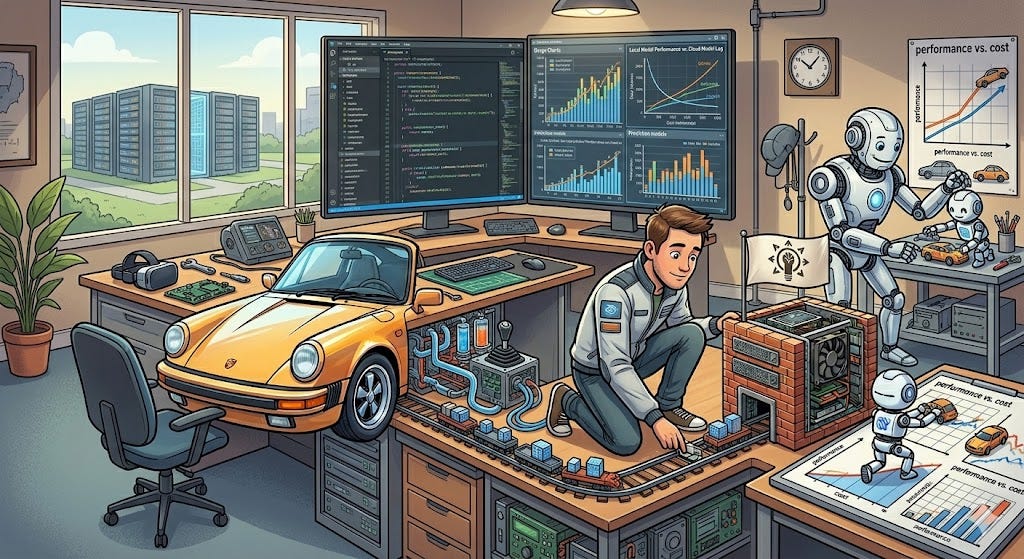
$2,000.
That has been my consistent monthly Cursor+Claude usage bill for the last six months. If we pull this out on an annual basis, that’s a whopping $24,000 a year. As a veteran Software Engineer, I have to ask the obvious question, why am I paying the equivalent of a luxury car payment and is there an alternative?
What exactly IS my $2,000-per-month buying me? It’s getting access to a capable AI model that helps me analyze my code, implement features, debug problems, organize tickets, and acts as a general amplifier to my daily workflow. The problem is that the AI model that I like so much, Opus, sits behind a locked door and only Anthropic holds the keys. If merely model quality was the issue, then I could take one of the open source models - Qwen, DeepSeek, or Kimi, tune it to my needs, and that would solve my problem. Now, there is a second reason why Anthropic gets to hold the keys and it is an entirely practical one. No one else can really run and operate the model at scale.
The reality of foundation AI models is that we’re forcing one gigantic model to impersonate expertise for billions of completely different users at once. Claude has to be smart enough to help me debug a production issue AND smart enough to apply my wife’s AP English grading rubric AND help my teen daughter do her Chemistry homework. One model, three completely different humans, all served simultaneously from the same feature-set bowl.
All that knowledge and understanding takes a lot of memory. Kimi K2.6 has 1T parameters and Opus 4.7 is rumored to have as many as 1.6T parameters. This is memory that a typical end-user machine doesn’t have, but a massive data center does. That means the only way to access these models - Codex, Claude, or Gemini, is through their APIs. These models are so large, that even if tomorrow morning Anthropic were to give the keys to the kingdom and let you download the Claude model, and even if you somehow had enough raw storage to do so, you certainly wouldn’t have enough compute or power to actually run it.
There’s a second self-induced roadblock. Over the last decade, we’ve stopped buying high end computers. Whether it’s video editing, data analytics, or software development, most of the real heavy lifting now happens in the cloud. Our local devices only need to be powerful enough to make Chrome tabs and Zoom calls feel slightly less painful. The high-end workstation is a relic of the past, the Macbook Air is the standard-issue default. The cloud didn’t eliminate the workstation, it outsourced it, and then put a hefty premium on it.
None of this is new. Computing has been swinging between centralized and personal its entire history.
We went from room-sized mainframes, to terminals, to personal computers sitting on every desk. With each swing, compute moved closer to the human operator. As demands on the work being done increased, local computer power increased with it. Eventually, we had high-end workstations that cost the same as a new car. Most engineers would much rather have the equivalent of a car’s worth of money in their paycheck, than a car’s worth of computer sitting under their desk. Thankfully, the Internet era arrived and we began the shift back, moving applications into the cloud and giving everyone what can be called the ChromeTerminal to use those applications. That brings us to the present day.
The pendulum is starting to swing back.
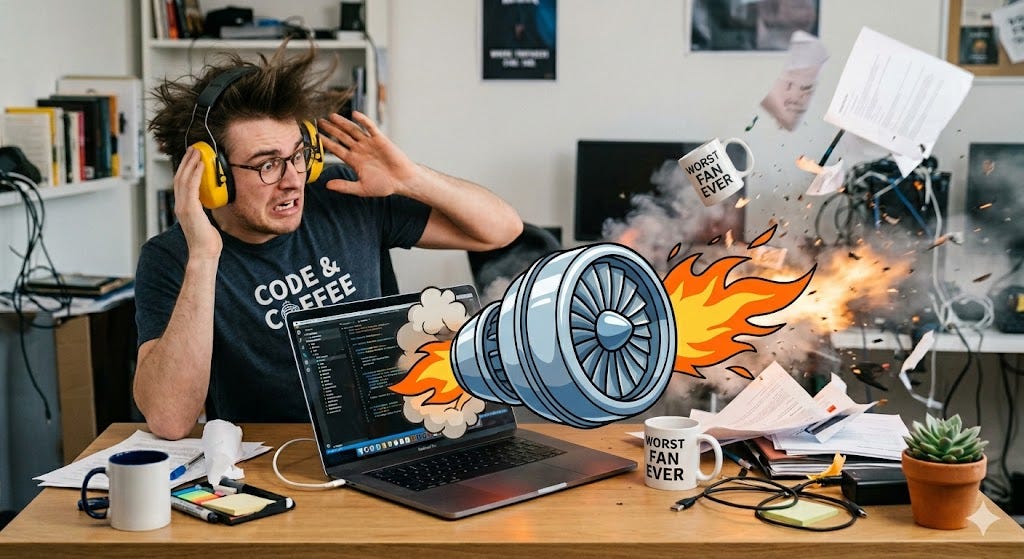
Even if you don’t intend to run a model locally on your machine, the tools of the trade, Cursor and Claude Code, are notorious resource hogs. Even basic development on a moderately sized codebase can bring a standard MacBook to its knees. The entire cycle of searching the local files, streaming the results over to the model, getting yet-another tool execution command, and running all those tools in parallel is pushing our standard-issue Macbooks to the breaking point. I love my Mac, but on many days, that fan is as loud as the jet engine of a 777. Ear protection is now required equipment for software development.
Where does all of this leave us?
Here are my three predictions for what’s coming up next:
The era of paying a car’s worth of money for Claude is ending. Open weights models are rapidly closing the quality gap with proprietary ones. As the open weights models get good enough for most end-user applications, along with the ability to tune them to have only what a business truly needs, they will become more attractive to operate than paying for the high-end subscriptions. The frontier labs will keep pushing the ceiling, but the floor for “good enough” is rising faster.
These models still demand immense compute, and local development is getting more resource-hungry, not less. That means two things: beefier developer workstations, and IT departments dusting off the on-prem playbook to run custom-tuned models in-house.
A new role is going to emerge, sitting somewhere between Software Engineer, IT, DevOps, and Business Operations. This is going to be an individual who understands the specifics of the business environment of their employer, the workflows of the employees, and how to tune and operate these models to maximum efficiency and enablement. Think Tools Engineer, the person whose job is to make every other engineer more productive, but pointed at AI, I’m calling it an “AI Enablement Engineer”. Their metric of success? Two numbers: How much faster the rest of the company moves because of them, and how much the AI bill drops while that happens.
As for me, I’m grateful for not having to personally pay the $2k/month Cursor bill. That invoice still buys something that can’t be replicated. But I’m watching what the open-weights crowd ships next while eyeing workstation spec sheets in a way I haven’t in a decade. The pendulum is swinging. The workstation isn’t dead. We just moved it into someone else’s data center for a decade, and I for one can’t wait to get my underdesk foot warmer back.